The four-part series on platform modernization covered the technical and financial discipline. There’s a fifth article that should have been there from the start. Modernization was always a cultural challenge. AI-accelerated modernization is a bigger one, because the fear underneath the resistance is now grounded in something real.
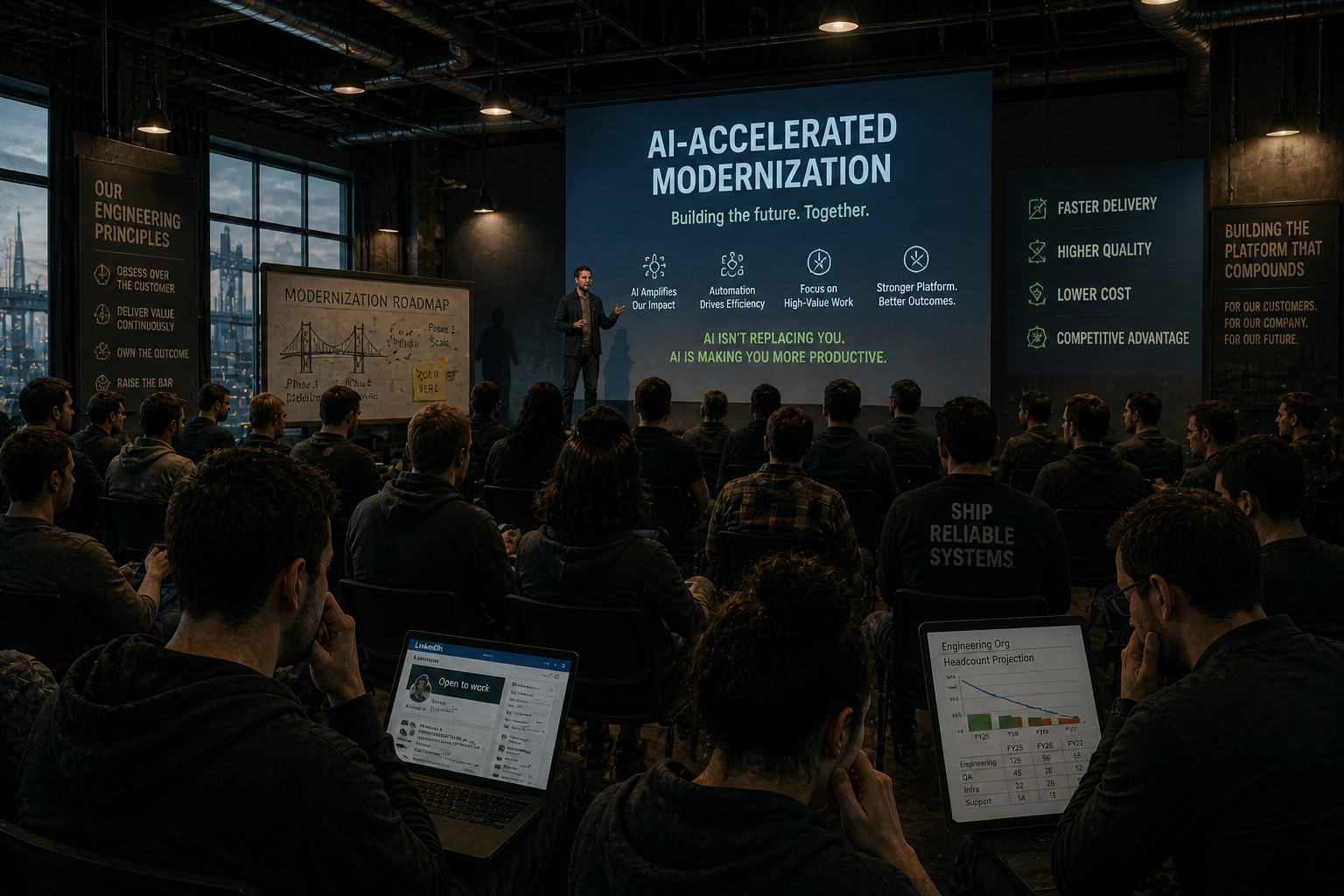
There’s a line that gets said in every modernization town hall right now. “AI isn’t replacing you. AI is making you more productive.”
Everyone in the room recognizes it as the corporate version of the truth. The CTO saying it knows it’s incomplete. The team hearing it knows it’s incomplete. Nobody says anything because the social contract of corporate communication is that we all pretend the rehearsed version is the real one.
That contract is broken now.
Your employees are smarter than you think. They read the same news you do. They watched the QA team get reduced. They saw the offshore contractors get cut. They are doing the math on what AI tooling means for their specific role, and most of them are reaching the same conclusions you are. They just aren’t allowed to say it out loud.
The result is that the standard change management playbook is failing right when CTOs need it most. The reassurances don’t reassure. The talking points sound like talking points. The team smiles in the meeting and updates their LinkedIn the next morning.
Resistance Was Always Signal
The disciplined view of resistance is that it carries information. The team member pushing back is telling you something. The job isn’t to overcome the resistance. It’s to read what it’s saying.
This was true before AI-accelerated modernization. It’s truer now. The “what about my job” question used to be answerable with “your job is safe, just different.” That answer is no longer reliably true. Sometimes the job is safe. Sometimes it’s different. Sometimes it’s gone. The honest response depends on which is happening, and the team can usually tell which one applies to them before the leader does.
Most CTOs are going to mishandle this phase. The ones who don’t will be the ones who treat resistance as signal rather than as friction to manage around.
The Four Phrases
Run any modernization long enough and you will hear four phrases. Run an AI-accelerated modernization and you will hear all four in the first month.
”We can’t do that.”
What it used to mean: a capability claim or organizational constraint.
What it usually means now: I know that if we do that, my role becomes redundant, and I’m not going to volunteer to make myself obsolete.
This is rational self-preservation, not obstruction. Treating it as obstruction is asking someone to enthusiastically participate in their own elimination. That is not a reasonable ask. The pretense that it is destroys trust faster than the underlying change does.
The honest response is to acknowledge what’s at stake and have the real conversation. “What I’m hearing is that this changes your role. Let’s talk about what that actually looks like.” Most of the time, having the real conversation gets you further than another round of reassurance.
”It’s how we’ve always done it.”
What it used to mean: institutional inertia. Defensive attachment to legacy practice.
What it usually means now: the current way of doing it is what makes my expertise valuable. If we change to a way that an AI can do, my expertise becomes commodity.
Senior engineers who built deep knowledge of legacy systems are watching that knowledge become less valuable in real time. The pushback isn’t stubbornness. It’s grief. They are mourning the obsolescence of their own expertise.
The senior engineer who knows the legacy system best is also the one with the most to teach the team about why the current system exists. Their knowledge has more value to the modernization than to the post-modernization platform. Compensating them as a teacher rather than discarding them as a holdout is both more decent and more strategically useful.
”Our clients won’t like that.”
What it used to mean: customer-protective deflection. Sometimes legitimate, sometimes a shield.
What it usually means now: the most factually grounded of the four phrases, and the most often dismissed.
The team member is reporting actual customer signal that didn’t make it into the modernization plan. AI-accelerated modernization moves so fast that customer-side concerns get steamrolled. When the engineer raising this concern is also worried about their job, leaders dismiss it as self-interested. That dismissal is a mistake. The customer concern is usually real even when the messenger has motives. Both things can be true.
The honest response is to investigate the customer claim, not the messenger. “Tell me which clients said this and what specifically they said” is the conversation. Nine times out of ten, you find a real customer expectation the plan missed.
”What about my job?”
The honest one. The one most leaders pretend isn’t being asked.
What it used to mean: anxiety, often unfounded.
What it usually means now: I have looked at what AI tooling can do, I have looked at what my role consists of, and I have done the math. I am asking you to confirm or deny what I already suspect.
The standard corporate response is to deflect. “AI isn’t replacing you, AI is making you more productive.” The line is sometimes true and sometimes false, and the team can usually tell which. Repeating it when it isn’t true is the single most damaging thing a CTO can do during AI-accelerated modernization.
The honest version sounds like this. “Here’s what I think happens to your role over the next 12 months. Here’s what I don’t know yet. Here’s what I can commit to about how this gets handled. If your role is going to change significantly or go away, you are going to hear it from me before you hear it from anyone else.”
That conversation is hard. It is also the only one that preserves trust. The CTO who has it credibly is the CTO whose team stays. The CTO who deflects is the CTO whose best engineers update their LinkedIn that night.
Why CTOs Get This Wrong
Three patterns explain most of the failures.
They repeat corporate messaging they know is incomplete. The CTO hears “we’re not replacing people, we’re augmenting them” from leadership and repeats it to the team. The team has more accurate information about the actual work than leadership does. They can tell when the line is true and when it’s not. Repeating it when it’s not destroys credibility on every other thing the CTO says.
They confuse compassion with evasion. Telling someone their role is at risk feels harsh. Saying nothing feels gentler. It isn’t. The kind version is the one that gives the person enough advance notice to make decisions about their own career. The “kind” deflection often turns into a sudden announcement four months later, which is the actual cruelty.
They assume the team can’t handle the truth. Engineers who debug distributed systems can handle hearing that their role is changing. The team is full of adults with careers, families, and skills. Treating them as if they can’t process accurate information about their own situation is insulting, and they notice.
The pattern across all three: the CTO is performing a version of leadership they think the situation calls for, rather than being honest about what’s actually happening. The performance fails because the team is sophisticated enough to see through it.
What Honest Looks Like
Not change management theater. Four practices.
Be the source of honest information. When the team has a question about how AI tooling affects their role, they should be able to ask the CTO and get an answer that matches reality. “I don’t know yet, here’s when I will” is a credible answer. “Don’t worry about it” is not.
Don’t repeat lines you know are false. If the talking points from comms or HR don’t match what’s actually happening in engineering, push back internally. Don’t deliver them to your team. The talking points exist to manage external messaging. Your team sees the internal reality every day.
Give people enough notice to make decisions. If a role is going to change significantly or go away in the next 6-12 months, the person should know as soon as you know with reasonable confidence. The notice has costs. The alternative is worse: losing the trust of the entire team when the announcement happens without warning.
Treat the people whose roles are ending with dignity. Severance, references, time to find the next thing, no asking them to train their replacement without acknowledgment. AI-accelerated modernization will create more of these situations than past modernizations did. How they get handled becomes part of the company’s reputation in the engineering market within months.
The Harder Truth
Doing this well is harder than doing it badly. It costs more time. It costs political capital when you push back on talking points or insist on giving the team longer notice than the comms plan allows.
For CTOs who plan to run multiple modernizations across a career, the trust investment pays back. The team that watched you handle this honestly is the team that helps you run the next one. The people whose roles ended on your watch and were treated well will refer engineers to you for the rest of your career.
For CTOs treating modernization as a one-time project, the math looks different. You can probably get through one with the deflection playbook before the costs catch up. But the CTOs running modernization as a one-time project aren’t usually the ones being asked how it should be done. There’s a reason for that.
Resistance Is What the Team Is Telling You
The team is telling you what they know. They know more than you think. They have read the news. They have done the math. They are watching what you do and listening for the difference between what you say and what you mean.
The four phrases are signal. The discipline is to listen to what they’re actually saying, not to the corporate-friendly version of what you want them to be saying.
The CTOs who get this right will keep the team that builds the next platform. The ones who don’t will lose the institutional knowledge they need just as the modernization hits its hardest phase, and they will spend the next year wondering why the modernization stalled when “everything was on track.” It stalled because the people who knew how to make it work stopped trusting that you knew what you were doing. They didn’t quit dramatically. They just stopped putting in the discretionary effort that modernization requires. The drift signal in the metrics will look like an execution problem. It isn’t. It’s a trust problem that started months earlier when you delivered a talking point you knew wasn’t true to a room full of people who knew it wasn’t true.
That’s avoidable. It requires honesty harder than the script. It requires treating the team as adults. It requires being willing to say the parts of the truth the comms plan doesn’t include.
That’s the work. Most CTOs won’t do it. The ones who do will be the ones whose teams stay.